Field recordings · spoken fragments
Collect sounds with a purpose
Recording is easy; collecting is a craft. The difference is intention. When you go out with a question, such as "what does this street sound like at its quietest?" or "which sounds in my kitchen are rhythmic?", you return with material that already wants to be arranged. When you record everything, you return with a hard drive full of maybes.
Start with a listening walk
In the early 1970s, R. Murray Schafer and the World Soundscape Project at Simon Fraser University in Vancouver began documenting everyday acoustic environments. Composer Hildegard Westerkamp, part of that group, later developed the "soundwalk": a slow walk where the only task is to listen. Schafer's book The Tuning of the World (1977) introduced terms like keynote, signal and soundmark that are still handy for collagists.
1A fifteen-minute soundwalk
- Walk a familiar route without headphones or recorder. Move at half your usual speed.
- Note one keynote: the background you stop noticing (traffic, ventilation, wind).
- Note three signals: sounds that demand attention (a bell, a shout, a reversing truck).
- Note one soundmark: a sound that could only belong to this place.
- Go back with the recorder and capture only those five.
Recorder basics that matter
You do not need to master every menu. Four settings cover most situations. Record in WAV, not MP3, so you keep full detail for editing; 48 kHz at 24-bit is a sensible default. Set the input gain so that normal peaks land around −12 dBFS on the meter, which leaves headroom for surprises. Switch off automatic gain control and noise reduction, because they pump and smear exactly the textures you want. And use a foam or furry windscreen outdoors, even on calm days.
Two habits will save you later. Speak a short "slate" at the start of each take ("market, fish stall, close, take two") and record ten seconds of room tone, the ambient sound of the space with nobody doing anything. Room tone becomes invaluable when you need to patch a gap.
Close, middle and far
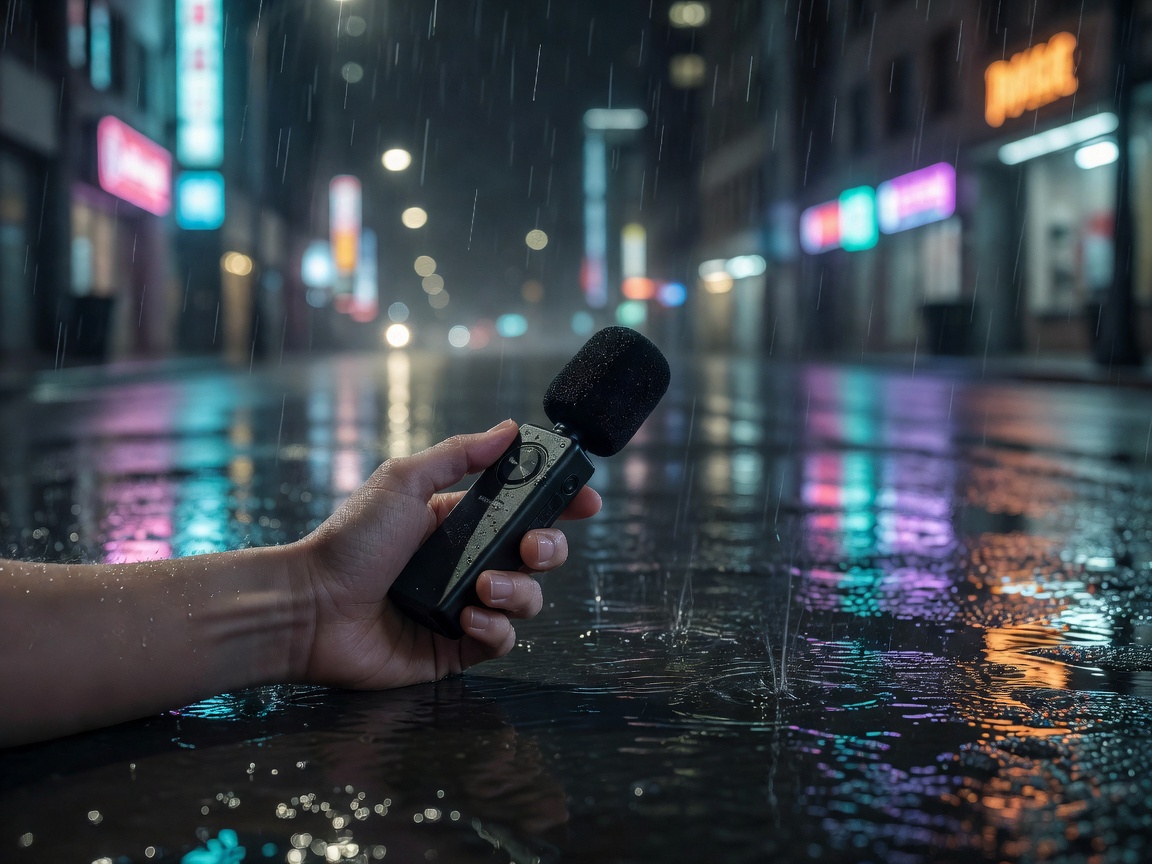
Distance changes a sound more than most effects ever will. A dripping tap recorded from two centimetres is intimate and percussive; from across the room it becomes part of the space. For every important source, try three takes: close, middle and far. Later you can move between them to create a sense of zooming in and out, something Chris Watson's nature recordings do with remarkable restraint.
Distance changes a sound more than most effects ever will.From this page
Collecting spoken fragments
Voices are magnetic. Even a single word pulls the listener's attention to the front of the mix, so use spoken material carefully. Ask friends to read something neutral, such as a recipe, a list of station names, or instructions for assembling furniture. Neutral text lets the sound of the voice, rather than the meaning, carry the piece. Record a few versions: normal speed, very slow, whispered, and from across the room.
Always ask before recording someone whose voice could be recognised, and tell them how the piece might be shared. A short written note or a recorded spoken agreement at the start of the take is good practice. In public spaces, rules differ between countries, so treat permission as your default rather than an afterthought. The finishing guide covers this in more detail.
Keep a simple log
A collection is only useful if you can find things. Name files consistently, for example 2026-03-04_kitchen_kettle_close_01.wav, and keep a plain text log with one line per file: what it is, where, and one descriptive word. That descriptive word ("grainy," "swelling," "brittle") often becomes the reason you choose a sound later.
2Build a ten-sound vocabulary
- Collect two continuous sounds, three percussive sounds, two voices and three "odd" sounds you cannot easily name.
- Trim each to its best eight to twenty seconds.
- Listen to all ten in a row and remove the one that feels most like another.